June was a special month in the Grumeti concession, as it marked the arrival of the great migration. This year, the herds came early, arriving on the 3rd of June. The plains came alive with sound, especially during the rutting season, when male wildebeests loudly competed to mate with females in heat. It is a dramatic time, full of energy and movement, as bulls chase after females and gather them into small groups, even securing shady spots where only females are allowed to rest. During this time, nearly half a million females conceive, ensuring the future of the herd. As the wildebeests move through the land, they feed on the tall grass left by the seasonal rains. At the same time, they fertilize the soil with their droppings, helping the land to stay rich and healthy. This natural cycle has gone on for centuries and is a vital part of the ecosystem. The herds continued to be around until the end of the month.
The arrival of the herds also drew the predators. Lions, cheetahs, hyenas, and other hunters are strong and well fed thanks to the abundance of prey.
For visitors lucky enough to be in Grumeti during this time, they had an unforgettable experience. The sheer number of animals, the sounds of the rut, and the powerful scenes of life and survival are breath-taking. June truly offers one of the best wildlife spectacles in the world, showing the raw beauty and rhythm of the Grumeti and Lamai reserves.
Here’s a June sightings snapshot for Grumeti:
Lions
The concentration of prey created incredible opportunities to witness the raw drama of the wild, chases, hunts, and intense moments between predator and prey unfolding in plain sight.
- Butamtam Pride settled around Chui drainage, Pundamilia, and Koroya Hill areas. There is hope that a few females have new cubs, as they were seen heading into the drainage several times, and one female showed clear signs of lactation.
- Sabora Pride extended their territory further south toward the Nyasirori area. They were frequently seen moving between Sabora, Sabora drainage, and Nyasirori plain.
- Ridge Pride shifted away from Sasakwa Hill and were observed in their usual range along Fungo, Mak Link, Sabora Access, and the Serengeti Road.
- Members of the Mkuyu Pride were seen along the Grumeti River, downstream of German Bridge. One of the females was accompanied by two tiny cubs estimated to be around eight weeks old.
- Kombre Pride females were spotted at Old School area, Sasakwa Dam and even further south towards OP 7, a surprising movement, as they had never been seen that far from their original territory. It is likely the noise of wildebeests drew them in, offering an irresistible food buffet.
Leopards
June will be remembered for having the highest number of leopard sightings in the concession, including both shy and relaxed individuals. This increase may be linked to the arrival of migratory herds in the area. Many leopards took advantage of the abundance of wildebeest calves, hunting them for food. To avoid losing their kills to larger predators, they often dragged the carcasses up into trees. This behaviour helped protect their meals but also made the leopards easier for us to spot during game drives.
- A mating pair was seen along Mbogo drainage, and with successful mating, we may expect new cubs in about three months.
- An adult male and female were spotted feeding on a wildebeest calf kill high up in a sausage tree, just south of the Balloon Lounge site.
- A very shy female was seen near Sabora camp. We suspect she may have come from Serengeti National Park, where she likely grew up with no game viewers around her.
- A shy female with one cub was observed along Mbogo drainage, upstream of the Fort Ikoma Road.
- A shy male was seen along the Raho drainage, upstream of the Kigelia Crossing.
- Another shy male was seen with a wildebeest kill up in a sausage tree in the Albizia woodland.
- A shy female was spotted west of Colobus Crossing.
- A male leopard was seen resting up in a tree west of Bangwesi Hill.
- A female was seen hunting a wildebeest calf along Raho Drainage near Kigelia Crossing.
- A male leopard was seen with a wildebeest kill high in a Balanites tree, southeast of Sasakwa.
- Near month end, we found a shy male with a wildebeest calf kill up in the sausage tree.
Cheetahs
With the migration in the area, the grass was heavily trampled, resulting in shorter grass across much of the concession. This open landscape attracted cheetahs and smaller antelopes like gazelles. The shorter grass made it much easier to spot them.
- A large male cheetah was spotted several times throughout the month, moving between Nyati Plain, Pundamilia Hill, and the Nyasirori area. He took full advantage of the abundance of wildebeest calves in the concession, which served as his main source of prey.
- The iconic veteran male made two appearances north of Sabora camp in the middle of the month. He looked to be in excellent condition. Known for his wide-ranging territory, he had not been seen for several months, so it was a welcome surprise to have him back in view.
- A female cheetah was also seen twice during the month, once along Nyati Plain and again to the south of Koroya Hill.
Elephants
Elephant numbers were noticeably lower this month compared to previous months. This change is likely due to the large presence of wildebeests in the area. Despite their reduced numbers, the elephants that remained in the concession offered some of the best viewing opportunities throughout the month.
- Kombre drainage and the Albizia woodland hosted the highest concentration of these magnificent creatures throughout the month, making it a true hotspot for sightings.
- Decent herds were regularly spotted across the Sasakwa plain, and interestingly, we observed them on Sasakwa Hill during the night hours.
- On the western edge of the concession, large herds made impressive appearances.
- As always, the Sabora area did not disappoint, with strong numbers of elephants frequently seen around the camp and surrounding areas particularly along the Sabora drainage.
- Good herds were also observed moving gracefully through the bushes around Marula and Balanitis Explore Camps, gradually making their way south toward the Raho drainage.
- Medium-sized herds were seen around Faru and along the Grumeti River, especially in the afternoons, as they gathered to drink and wallow in the cooling waters, a serene and beautiful sight.
Buffalo
Buffalo numbers remained steady throughout June, showing little change from previous months. As the dry season set in, the herds followed their usual patterns, gathering around waterpoints across the concession. Their presence was consistent and predictable, often seen moving through the plains in large groups or resting during the heat of the day. The reliable appearance of these massive herds added to the classic safari atmosphere, offering great viewing opportunities and a sense of continuity in the changing landscape.
- A very large herd was seen moving across the open plains of Sabora, Fisi, and Fungo, eventually reaching the Rubana River.
- On Sasakwa Plain, as is often the case, a decent-sized herd was observed roaming around Sasakwa Dam, Old School, Farsi, and north of OP Seven.
- Albizia woodland hosted the largest herd of the month, with buffalos frequently moving between the woodland and the marsh area.
- In the Grumeti west region, a small herd was seen around Pelican Pan and German Bridge, along the Grumeti River.
- A large herd was recorded in the area around Rhino Rocks, morum pit, Grumeti north drainage, Biribai, and near Faru Faru Lodge.
- Another large group was seen south of Koroya and Pundamilia Hills, gradually wandering further south towards Nyati plain.
- A large herd also roamed the open plains of Gambaranyera, near Explore camps, the Raho drainage, and along the Rubana River, in search of water.
- A small herd was sighted in the woodlands west of Bangwesi Hill and near the Rokare drainage.
- A very large herd was observed moving through Kombre Drainage, Uwanja wa Ndege, around Serengeti House, and north of Rhino Boma, offering some spectacular sightings.
Rhinos
The male black rhino was seen very often this month, and he appeared in good shape.
June sightings snapshot for Lamai:
Lions
Lamai Triangle/Wedge never disappoints, it’s consistently one of the most exciting areas for lion sightings. This iconic landscape, with its open plains and scattered rocky outcrops, provides the perfect setting for dramatic encounters. Whether it’s prides on the move, lions lounging in the sun, or moments of intense hunting action, Lamai continues to deliver unforgettable experiences for every guest lucky enough to explore its wild.
- The Kigelia Pride, consisting of two majestic males, seven lionesses, two sub-adult males, and five beautiful cubs, totalling 16 members, has been seen regularly around Lamai throughout the month of June. Their roars echoed across the plains, a true testament to their dominance.
Leopards
June turned out to be one of the best months for leopard viewing. Despite their naturally elusive nature, we were fortunate to enjoy consistent encounters throughout the month. More interestingly, all leopards seen were relaxed, offering guests unforgettable moments with one of Africa’s most secretive big cats.
- A female leopard was frequently seen at Alex Walker plains and Daraja la Minazi.
- A female with one cub seen along Kenyangaga drainage upstream of Daraja Mbili.
- A female seen very often near the Maasai and Serengeti boundary.
Cheetahs
Without cheetahs, the open plains of Lamai would feel incomplete, especially given the abundance of Thomson’s gazelles that thrive there. The combination of wide, open landscapes and plentiful prey makes Lamai a perfect hunting ground for these sleek and agile predators, adding to the area’s rich and dynamic wildlife experience.
- Coalition of two brothers dominated the area from the Maasai Mara boundary all the way to Korongo la Fisi.
Elephants
Lamai has always been one of the favourite places for these magnificent creatures of the wild.
- There was a large herd seen almost every day at Kampikampi open plain.
- Another beautiful herd seen along the Kenyangaga drainage.
- A few bachelor bulls were seen moving around open plain and along the Mara River as well.
Buffaloes
There were some buffalos seen throughout the month.
- There was one herd seen on the open plains of Korong la Fisi.
- A large herd was seen along Korongo la Kigelia and the Maasai Mara boundary area.
- Another herd spent time along the Alex’s plains.
Plains game
The open plains near the Maasai Mara and Serengeti were alive with hundreds of Thomson’s gazelles, resident zebras, and wildebeests, offering the best game viewing experience.
Other interesting sightings
As always hippo and crocodiles were amazing to watch, especially as they basked on the Mara riverbank in the warm mid-morning sun.
Leopard, the warthog, and the night thieves
Story by Baraka Mtalo
In the heart of the Grumeti, we had one of the most unforgettable moments of our lives. It all started when we saw a big male leopard bringing down a fully grown warthog. The hunt was intense and took time, the warthog had a thick, strong neck, and the leopard had to hold on tightly and patiently before it finally went down. The struggle was powerful. The leopard, using all his strength, caught the warthog and then dragged it toward a nearby sausage tree.
It was a heavy load, and the effort was clear. He pulled and dragged the warthog slowly, stopping now and then catching his breath. He tried to lift the carcass into the tree, but it was too much. With great effort, he managed to get it halfway up the trunk. Finally, he collapsed on a strong branch, chest rising and falling, completely worn out.
We watched in silence for nearly an hour. The leopard didn’t move much. He was so tired he couldn’t even start eating. As the sun set and darkness began to cover the land, he finally gathered enough strength to begin feeding on his well-earned meal.
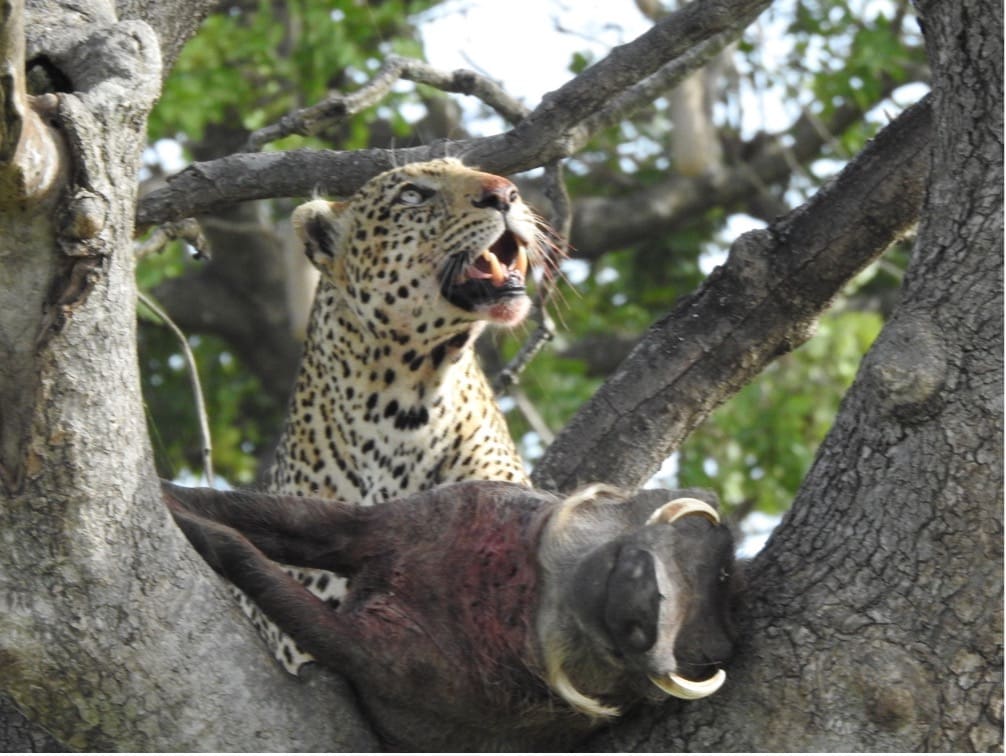
He stayed in that same tree for three days. Each day, he ate a little, always keeping close to his kill, making sure no scavengers could steal it. It was peaceful just the leopard, the tree, and his prize. But everything changed on the third night.
We were out on a night drive when we felt the atmosphere shift. The air grew tense. A pride of lions had picked up the scent of the kill and started moving in. I stopped the vehicle. In the distance, we could see the lions circling the tree, their eyes glowing in the dark.
Then, something we never expected happened. One bold lioness climbed the tree. It was a rare and shocking sight. She reached the carcass, startling the leopard. He had no choice but to retreat higher into the branches, away from the danger. Within seconds, the lioness grabbed the warthog and dragged it down from the tree. The leopard didn’t fight back. He just watched from above, silent and defeated, his hard work stolen in a moment.
It was a powerful reminder of how tough life is in the wild. Out here, nothing is guaranteed. Even the strongest hunters can lose their prize. In the African bush, timing, patience, and strength are everything. This was nature at its rawest and we were lucky to witness it.
The Lamai Triangle / Wedge
Story by Johnson Paul (JP)
June in the Lamai Triangle was full of life, surprises, and unforgettable moments. This beautiful area, tucked between the Isuria Escarpment, the Mara River, and the border separating Serengeti from the Maasai Mara, stretches over 776 square kilometres. It’s a mix of open grasslands, woodlands, and river areas, and at this time of year, it started waking up in the most exciting ways.
The land is split in two by a road running from Lamai Gate to Kogatende Bridge. On the southern side of this road, the area is mostly woodland and riverine habitat. The game viewing here was a bit quiet in June. You could still see zebras, impalas, and topis, and near the river, hippos and crocodiles were always around. If you were lucky, you could catch giraffes and elephants near the Kenyangaga drainage line, where they came to drink water or feed along the riverbanks.
But the real action was in the north! This part of Lamai is covered mostly by open grasslands, dotted here and there with small bushy patches. This is where the animals gathered in large numbers, Thomson’s gazelles, zebras, buffaloes, topis, elands, and elephants. And of course, where there is prey, the predators follow. A pride of 16 lions with two strong male leaders rule this land, moving between areas known as Miti Miwili, Korongo la Fisi, and Korongo la Minazi. Right at the edge of the border between Serengeti and Maasai Mara, two massive male lions were also patrolling their territory, crossing between the two reserves like true kings of the wild.
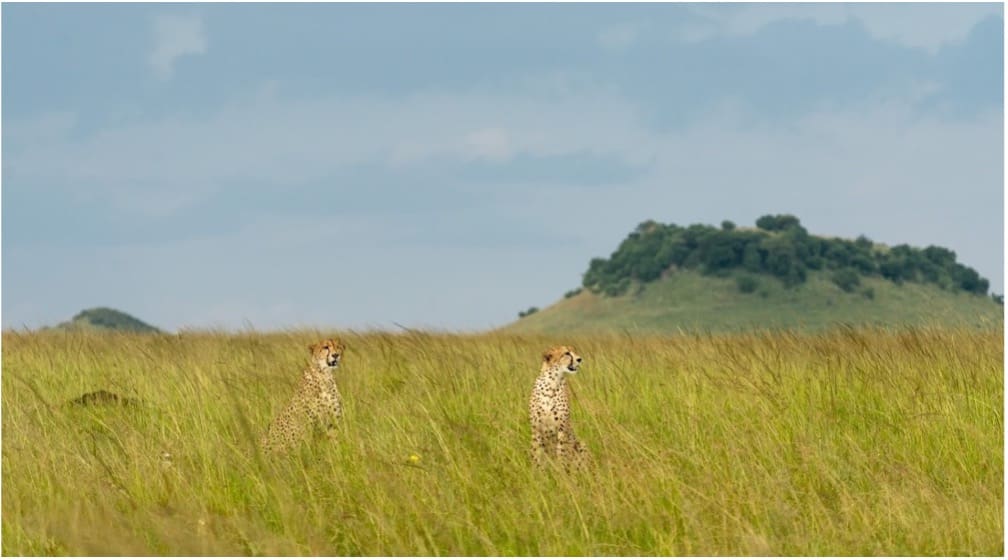
Leopard sightings were also quite good this month. With patience and luck, guests got to see these shy and beautiful cats more than once. But one of the biggest surprises came on June 22nd, when two famous cheetah brothers known for roaming between the Serengeti and Maasai Mara were spotted again for the first time since December. It was a joyful moment for guides and guests alike. The next morning, the brothers were seen again and successfully hunted a male Thomson’s gazelle. They stayed near Alex Walker’s Plain, the same place where they were last seen months ago. It felt like a homecoming.
Then came the most incredible sight of the month. The two cheetah brothers had wandered into leopard territory. Like any wild cats, they started marking the area—rubbing their scent on bushes and trees. One of those trees, a desert date tree, had a leopard resting quietly in the branches above. The cheetahs didn’t know he was there. But the leopard knew. And he wasn’t happy. In one sudden move, he came down the tree and chased the brothers away, defending his space with no fear. It was a rare and thrilling moment to see three powerful predators crossing paths, showing respect and rivalry in their own wild way.
Elsewhere, on the open plains of Kampikampi, something special was happening too. A few elephants were seen coming together, then more joined, and then more until there were about 80 elephants in one place. They touched trunks, made loud trumpet calls, and moved together as one big, united family. It was a peaceful, heart-warming scene and a perfect way to end an evening drive.
Now the land is getting ready. The tall grasses are still waving in the wind, but it won’t be long before the wildebeest arrive. When they do, they will mow down the grass and turn the area into a short grass plain making it even easier to see the big cats that call Lamai home. But even before they come, June has already given us a wild, powerful story that will be remembered for a long time.
The Music of the savanna
Story by Medard Fundi
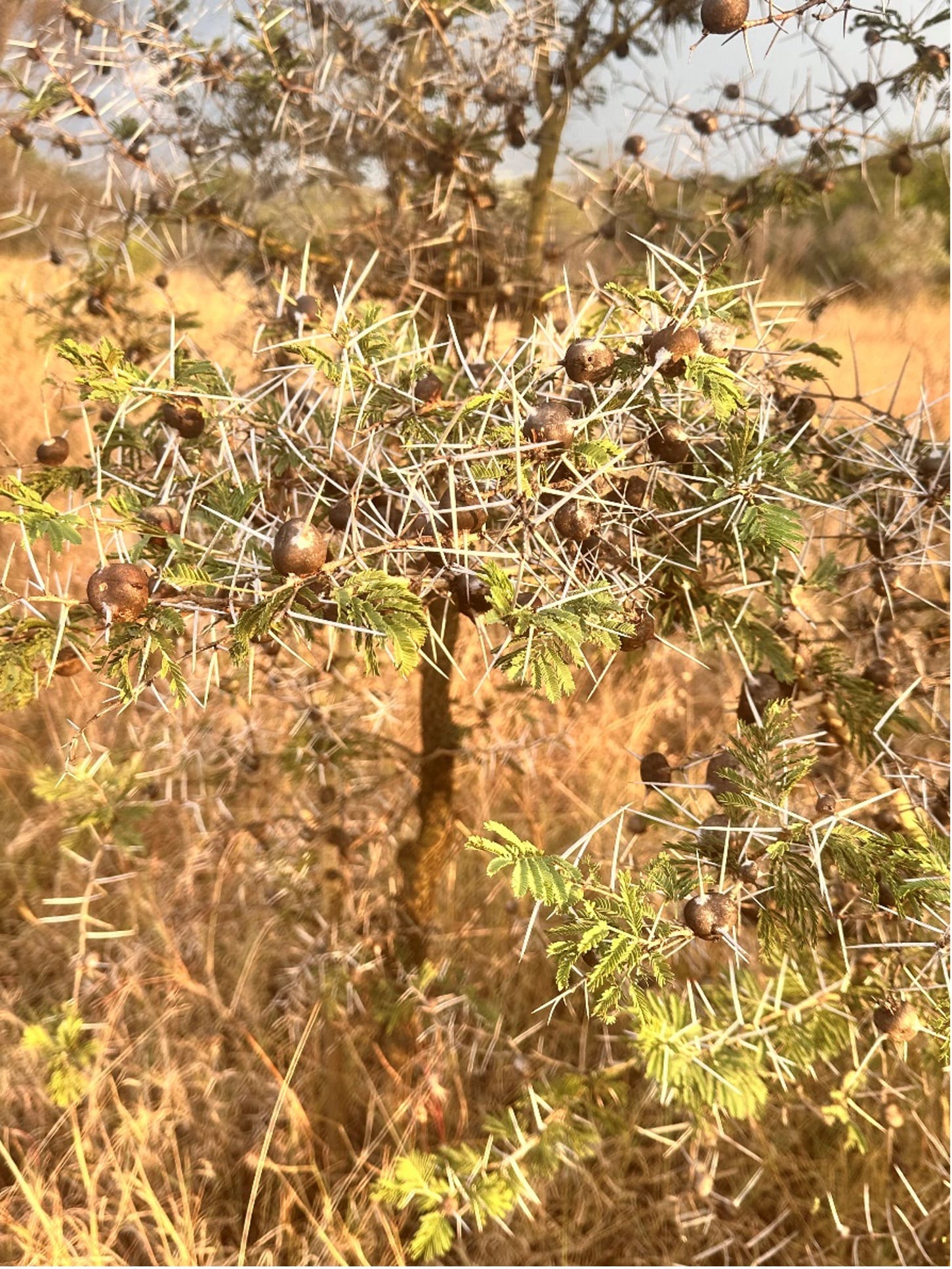
In the heart of the Serengeti, where golden grasslands stretch to the horizon, there stands a tree unlike any other. It’s called the whistling thorn acacia. People say it sings and when the wind moves through its branches, it truly does.
This tree has a special friendship with tiny ants known as cocktail ants. It grows round, hollow swellings called galls at the base of its thorns. These galls become homes for the ants. Not only shelter, but the tree also provides food to the ants which is mainly extrafloral nectar secreted by its glands located on the underside of the leaves, particularly along the midrib or leaf margins. This sugary liquid provides vital energy to the ants. In return for shelter, the ants fiercely protect the tree. Whenever a hungry animal tries to eat its leaves, the ants rush out and sting, driving them away.
But this clever design has another surprise. Over time, tiny holes form in the galls. When the strong dry-season winds blow through the tree in June, the air whistles through these holes. The sound floats across the savanna soft, high, and haunting. It’s as if the tree is playing a song, shaped by the land and carried by the wind.
As the dry season settles in, water becomes scarce, and the sun grows hotter. Yet the whistling thorn continues to sing. Some say it’s the spirit of the savanna speaking through the tree, reminding animals to stay strong through the hard times.
Giraffes often stop by to feed on the tree’s small leaves. They’re careful, though—one bite too many and the ants will come out. Still, the giraffes gently chew, while the tree’s music plays around them. Elephants walk past. Birds perch in its branches. Even lions rest beneath its shade, listening in silence.
To the animals of the here this is more than just a tree. It’s a part of their world, living and breathing, humming a song that connects them all.
And now, as the winds sweep across the land once more, the whistling thorn sings its melody, drifting through the plains, telling the story of a tree, some ants, and the music of the wild.
Download the full report