May has been a wet month, which is quite normal since it usually marks the end of the rainy season. During this time, the weather often changes quickly. In the afternoons, scattered thunderstorms appear in the sky. These storms create a beautiful and dramatic scene, with dark clouds rolling in and flashes of lightning lighting up the horizon. The sound of thunder echoes over the wide plains, and the smell of fresh rain fills the air.
However, the rains have caused many puddles and small pools of water to form all around the area. Because of this, animals do not need to visit the Grumeti River as often. They can find water nearby, so fewer animals were seen at the riverbanks this month. Even so, the open grass plains are full of life. The rain has helped the grass grow thick and green, providing plenty of food for grazing animals. Flowers are blooming, and many insects are buzzing around, enjoying the fresh plants. Birds, zebras, topi, Thomson’s gazelles and small herds of wildebeest move freely across the land. Predators like lions and hyenas are also nearby, watching carefully as they search for their next meal.
The combination of plants and animals, along with the dramatic weather, made this month a wonderful time to see the beauty of nature. The sights and sounds of the rainy season are truly something special to witness.
Here’s a May sightings snapshot for Grumeti:
Lions
May was nothing short of spectacular when it came to lion activity, with sightings of six distinct prides spread across the concession. The presence of these regal predators infused the entire reserve with a palpable sense of excitement, making it a great month for game viewing. A standout highlight was witnessing all six prides in different areas, still feasting on buffalo – a prey species that has become their staple diet in the lead-up to the return of the Wildebeest Migration.
- Momukomule Pride provides great sightings north of Sasakwa hill and around Sasakwa hill and inside the rhino sanctuary. The pride looks healthy with one of the females seen with three cubs of two to three months old.
- Butamtam Pride has been seen along the Sasakwa plains and the plains south of Sasakwa hills. The four new males have been keeping both the Momukomule and Butamtam Prides on different territories.
- Ridge Pride has been frequently seen at Sasakwa hill and they have been between Milele, Kilima and Sabayaya.
- Sabora Pride has been seen more often around Sabora camp and the western part of the camp with the extension territory south along Nyasirori plains. The whole pride has been seen in a very good condition.
- Nyasirori Pride made a brief return to the concession but most of the prides movements have been inside the Serengeti National Park this month.
- The West, Gambaranyera and Kawanga Prides haven’t been seen in the concession as most of their territory has been wet and, with the plains game avoiding the area, it has made these prides follow them to other areas.
Leopards
The month of May has unfolded with a remarkable abundance in leopard sightings. A steady rise in their appearance has graced the landscape, offering a rare and captivating glimpse into nature’s quiet resurgence.
- Mbogo Drainage female and her two subadults have been spotted more frequently around Faru Faru Lodge.
- Momukomule male has been seen on the northern side of Sasakwa hill.
- Subadult female from Mazingira female (weaned) seen below Sasakwa hill, in between Sasakwa Lodge and Serengeti House.
- Grumeti North male was seen this month after we had lost sight of him for about three or so months. He looks well fed and in very good condition.
- A skittish young male has been seen north-west of Sabora camp.
- An adult male was seen at the junction of Fort Ikoma Road and Sand Road.
- A shy female was seen inside the rhino sanctuary, we suspect this is the new female in the area with no territory yet.
- An adult male was seen east of the rhino sanctuary.
Cheetahs
- One adult male was seen east of Sasakwa hill. The sightings will improve as the tall grass starts to diminish.
Elephants
Due to the substantial rainfall during the month of May, the herds have become increasingly scattered, breaking into smaller groups. The widespread availability of lush, green grass throughout the concession has allowed them to disperse more freely across the open plains, along the Grumeti River, and throughout many tributaries. This abundance of grazing opportunities has significantly influenced their movement patterns, reducing the need for large congregations in specific areas.
- Singita Explore and the areas west of it had significant number of these humble giants which made an impressive scene for viewing them on the open plains of Gambaranyera and Kawanga.
- Sabora plains continued to be one of the routes for the herds moving off the ridge hills into the open plains into Raho drainage. It’s been an epic sight with the herds crossing the open plains.
- In Ikorongo the sightings of decent herds have been scattered from the east and the western side of Bangwesi hill and along the Rokare drainage.
- The central areas of the reserve had very large herd movements. Pundamilia and Nyati plains, Momukomule drainage, and Mazingira woodland had small to medium sized herds, spotted moving slowly and quietly along the wooded areas on their way to the plains.
- There were also herds seen west of Faru Faru Lodge, Grumeti River and along Mbogo drainage.
Buffalo
The month has been teeming with buffalo activity. As the open plains become increasingly waterlogged from seasonal rains, they’ve transformed into ideal grazing grounds for these massive herbivores. The lush, moisture-rich grasslands now offer abundant forage, attracting large buffalo herds to feed and roam. Meanwhile, temporary pools and mud-filled wallows scattered across the open plains have become essential. Not only do they serve as vital watering holes to quench the animals’ thirst, but they also offer relief from the midday heat.
- The plains of Sasakwa had a large herd that was roaming between Old School, Sasakwa Dam and below Kilima and Milele Villas. The movement of these herds of large bovines provided spectacular views from Sasakwa hill.
- The western part of the concession was not short of these large herds as the plains of Sabora and Gambaranyera have been great areas for the big herds.
- A big herd was seen along Grumeti River and the Triangle areas that stretched to Romoti woodland.
- A large herd has been seen more frequently west of Faru Faru and along Beribai plains. This herd hasn’t been moving big distances for the whole month of May.
- The Nyati and Pundamilia plains have been hosting the large herd that has been moving between the plains, and Grumeti River, and the boundary of Serengeti National Park.
- A large herd was spotted west of Bangwesi hill and on the northern side of the Mbega Bridge.
- A small herd was spotted on the plains of Pofu at Ikorongo.
- A bachelor groups has been spotted on the plains of Sasakwa, west of Sabora camp, and along Grumeti River and Chui drainage.
Rhinos
Two animals in the enclosure were spotted several times – all in good health.
Morning drama in the African bush
Story by Neema Ngowi
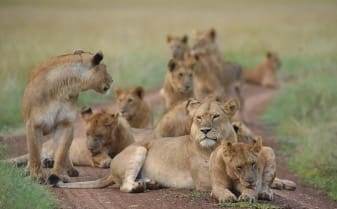
On the crisp morning of May 27th, as the first golden rays of dawn pierced through the acacia woodland, we embarked on a game drive that would soon unfold into an unforgettable spectacle. At approximately 6:30 AM, just north of Rhino Boma, our path intersected with the powerful presence of the Momukomule Pride – a formidable assembly of 13 lions, predominantly lionesses and cubs, moving in fluid unison through the savanna.
The pride was mobile, heading east with purposeful strides. The cool morning air buzzed with anticipation as we followed their graceful yet commanding procession. Soon, the lions’ direction led us to an unexpected discovery – a buffalo carcass, lying swollen and decomposing in the grass. Judging by the putrid stench that hung thick in the air and the state of the body, the buffalo had likely died of natural causes a day or two earlier.
As the Momukomule lions approached the carcass, their demeanour shifted from patrol to purpose. The cubs hesitated at first, noses wrinkling at the rancid odour, but the adult lionesses wasted no time in beginning to feed.
Then, the real drama began: Roughly 30 to 40 minutes into our observation, movement on the periphery caught our attention. Emerging from the bush came another pride of lions – this one composed of six individuals: two impressive males and four lionesses. As they drew nearer, it became clear that these lions belonged to the Butamtam Pride. But here’s where things got truly intriguing: the two dominant males accompanying the Butamtam lionesses were the very same males from the Momukomule Pride.
These coalition males had successfully asserted their dominance over both prides, a powerful dynamic in lion social structures. However, the encounter at the carcass quickly turned tense. The Butamtam lionesses, evidently hungry and drawn by the scent of the carcass, attempted to join the feeding. But their advance was met with aggression and hostility from the Momukomule females, who chased them off, asserting their dominance over the kill.
The four Butamtam lionesses, despite being part of the extended pride network through the shared males, were denied access to the meal – a harsh yet revealing display of the complex hierarchy and territorial tension that governs lion society.
To witness this rare interaction – two prides, one carcass, and a pair of dominant males holding sway over both groups was extraordinary. It was a raw, real, and riveting reminder of how power dynamics, survival instincts, and familial bonds play out. The air, still heavy with the scent of decay and dominance, seemed to vibrate with the energy of the encounter. That morning, we were not just spectators – we were privileged witnesses to a powerful chapter in the unfolding story of these apex predators.
Exciting cheetah sighting
Story by Silas Shayo
After a long afternoon game drive we were slowly making our way back to Faru Faru Lodge from the wide-open Sasakwa plains. The heat of the day had begun to settle, and the bush was calm, with only the distant calls of hornbills and the rustle of tall green grasses around us. The drive was nearing its end, and we were all relaxed, enjoying the last stretch of the journey.
Then, something caught my eye – perched on a fallen log, about 200 meters away, was a sleek, slender figure. Almost instantly, the animal disappeared, slipping silently into the tall savannah grasses. The glimpse was so brief that I couldn’t identify it with certainty. I told the guests I had spotted something unusual, possibly a leopard or maybe even a lioness, based on the posture and silhouette.
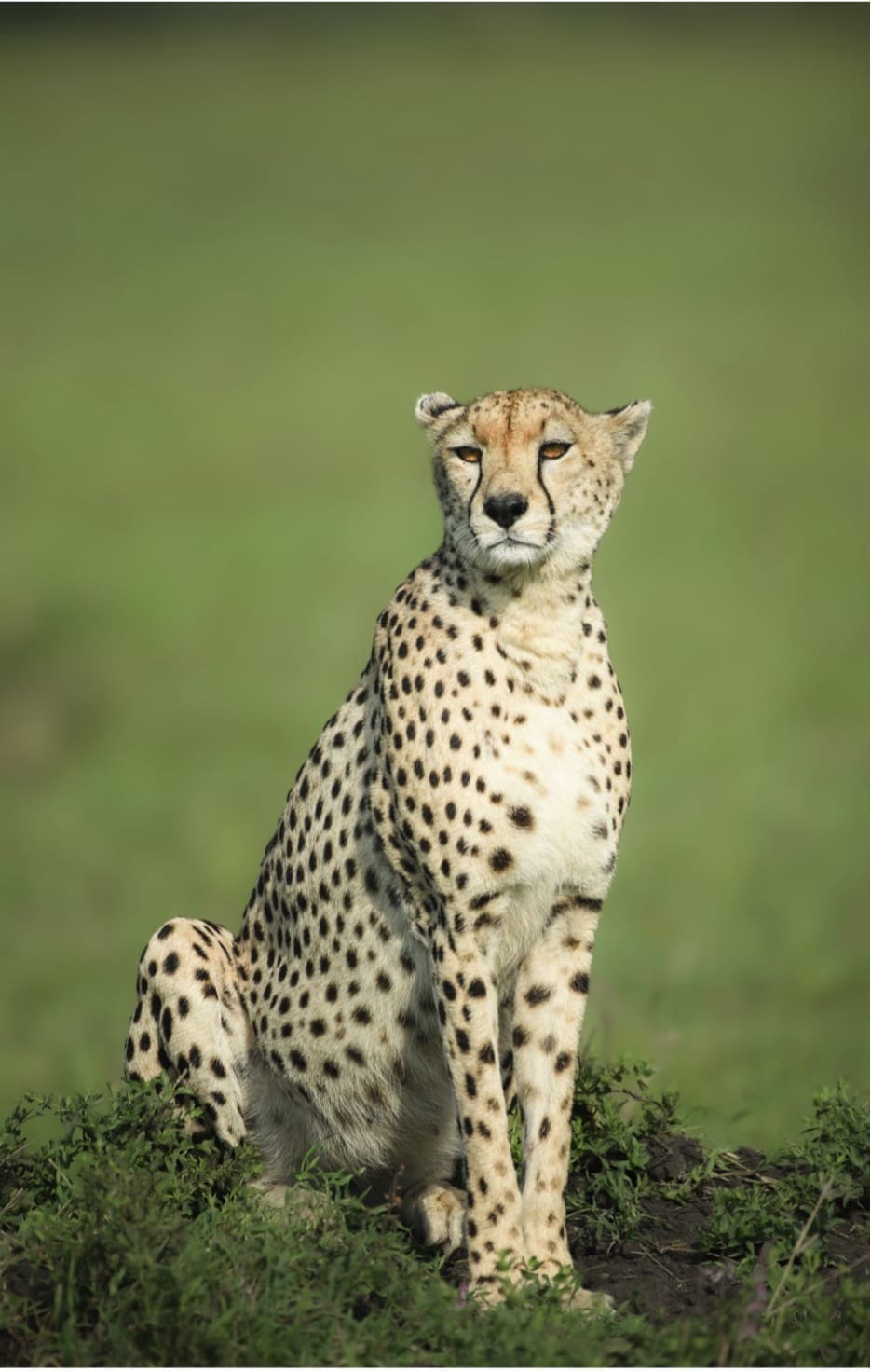
To be sure, I radioed nearby guides for support. Within minutes, Bernard and Francis arrived, and together we scanned the horizon with binoculars, carefully studying every movement in the grassland. Our patience paid off – emerging from the tawny sea of grass was a magnificent adult male cheetah.
His coat shimmered in the late afternoon light, dappled with perfectly spaced black spots, and his tear marks – those dark lines running from his eyes to his mouth – were clearly visible. He was in prime condition: lean, muscular, and alert, a true embodiment of grace and power. We were elated! It had been many weeks since a cheetah had been seen in our concession, making this encounter even more thrilling and seeing one in such an open, relaxed state felt like a privilege. The cheetah soon began moving eastward at a leisurely pace, following the dusty stretch of Fort Ikoma Road from the watershed junction. We followed at a respectful distance, the vehicle moving silently as we observed his fluid, almost hypnotic stride. He paused occasionally to scan his surroundings, his keen eyesight picking up every flicker of movement. The savannah around us was hushed, as if nature itself had paused to admire this iconic predator. The guests watched in awe, cameras clicking softly, but mostly just soaking in the unforgettable moment. It was one of those sightings that stays with you – a truly special day on the Singita Grumeti plains.
The art of chiselling
Story by Saitoti Olekuwai
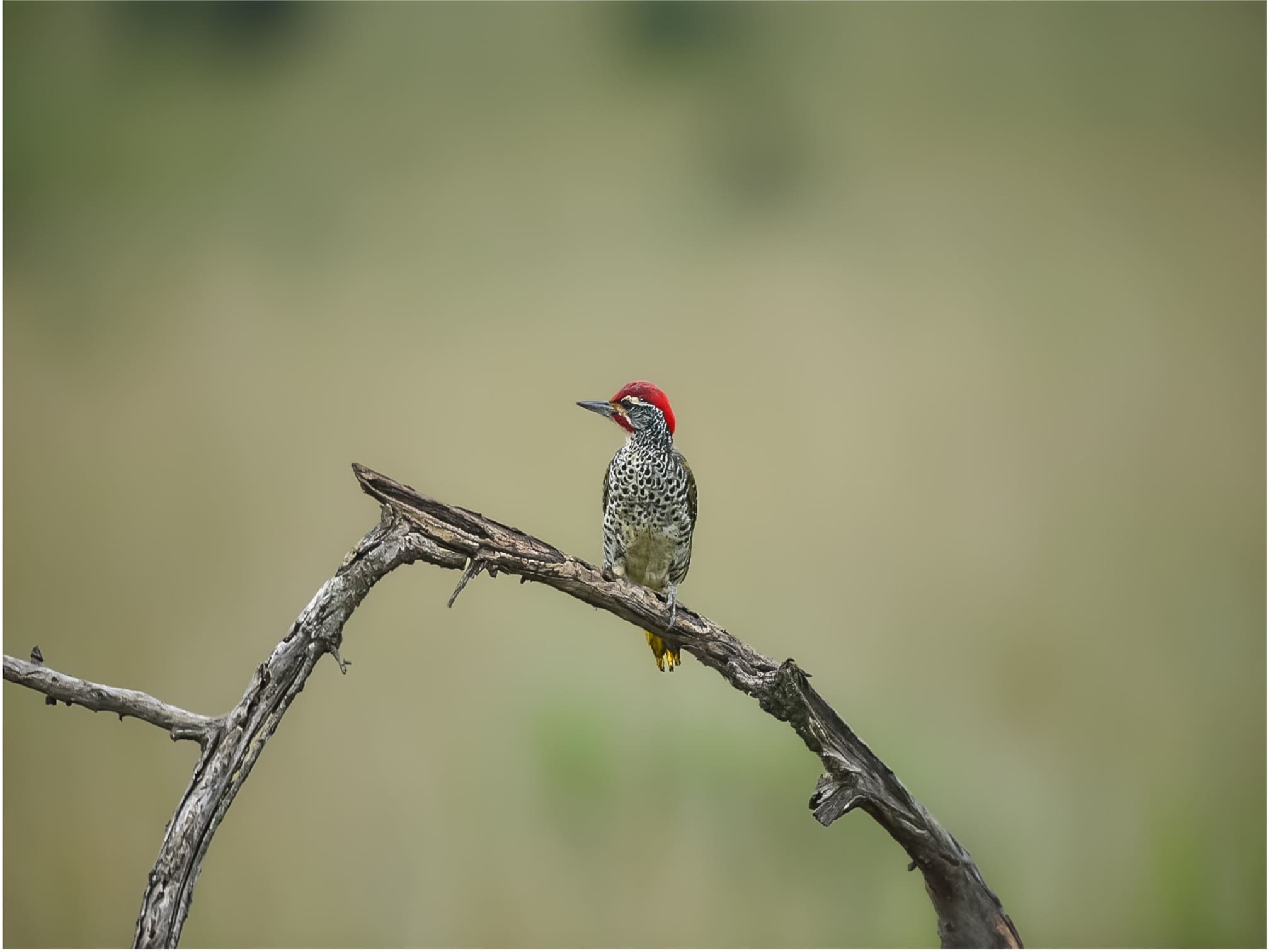
The Nubian woodpecker (Campethera nubica) is a fascinating and uniquely adapted bird, well-known for its extraordinary ability to peck up to 20 times per second – amounting to an astonishing 8 000 to 12 000 pecks in a single day. This incredible behaviour is not just a survival tactic but a marvel of evolutionary adaptation. Living in arid and semi-arid savannas, the Nubian woodpecker has evolved specialised features that allow it to thrive in its environment.
One of its most remarkable adaptations is its long, sticky, and barbed tongue, which can extend far beyond the beak. This specialised tongue acts like a spear and is perfectly designed for extracting insects and larvae from deep within tree bark and crevices. Even more impressively, the tongue wraps around the skull when retracted, forming a cushion that helps absorb the shock of relentless pecking – an adaptation that protects the bird’s brain from damage.
In addition to this, the Nubian woodpecker possesses an exceptionally hard and chisel-like mandible, which enables it to bore into wood with precision and force. This strong beak also serves a crucial role in communication. By drumming on hollow logs or dry branches, the woodpecker creates a resonant sound that echoes through the savannah – a form of acoustic signalling used to attract mates and to assert territorial boundaries. These drumming patterns are species-specific and can be heard from considerable distances, serving as an efficient and energy-saving way to communicate in dense habitats.
Altogether, the Nubian woodpecker is a testament to the power of natural selection, showcasing an incredible suite of anatomical and behavioural traits that allow it to flourish in the wild. From its shock-absorbing skull to its sound-producing drumming behaviour, every part of its anatomy has a purpose finely tuned by evolution.
Download the full report