In January, the weather has generally been dry, except for the last few days of the month. After brief rainfall in December the heat and moisture on the ground helped create the perfect conditions for grass to grow quickly. This rapid growth has attracted herds of plains game, such as topi, eland, Thomson’s gazelle and zebra, that are now seeking refuge in areas where the grass is shorter. These areas, located to the south-west and west of Sasakwa Hill and Beribai Plains, are part of a watershed. The land in these areas is dryer and the grass is short and green, making it a desirable spot for the animals. The changing weather patterns and the quick growth of grass have created an interesting shift as to where the animals are choosing to stay and feed. The Grumeti River has been flowing low and puddles of standing water on the plains have been sustaining the game.
January sightings snapshot for Grumeti:
Lions
January has been an exciting one for lion sightings, with lots of activities across the property.
- The Sabora Pride was mostly seen west of Sabora Camp stretching all the way to the Marula Bush Breakfast site. Their nine cubs are healthy and growing well.
- Momukomule Pride has been seen mainly in their territory which is Sasakwa Hill, Dikdik Ridge and occasionally they ventured close to the community grazing boundary.
- The Ridge Pride was seen frequently around Ridge Hills and occasionally below Milele Hills.
- The Nyasirori Pride spent most of the month along the boundary between the Serengeti and Grumeti Concession, these areas are productive in prey availability.
- The Butamtam Pride has been settled on the southern plains of Sasakwa Lodge, with all 18 cubs in good health. What an incredible sight it is to see this large pride at the moment.
- Mkuyu Pride was frequently seen along Grumeti River as their territory expands from Faru Faru Lodge to German Bridge.
Leopards
This month we had some amazing leopard sightings amid the growing grass:
- The Mbogo Drainage male was often seen along Mbogo Drainage, and north of Faru Faru Lodge.
- The Maridadi female was seen along Raho Drainage and east of Sabora Camp.
- Momukomule male was seen south of the rhino sanctuary.
- The skittish adult male was seen along Raho Drainage bordering Serengeti National Park.
- The skittish female was frequently seen south of Sasakwa Plains.
- A relaxed female was frequently seen north of Sabora Tented Camp. Also, a relaxed female was seen frequently below Sasakwa Hills.
- A relaxed adult male was seen frequently west of Sabora Camp, and a very relaxed adult male was seen often, north-west of Faru Faru Lodge.
Cheetahs
Due to the rainfall and tall grass in some areas, the general game has moved to higher ground across the reserve, which has led the cheetahs to these spots.
- The well-known Junior Veteran was seen on the southern side of Sabora, patrolling the territory on the plains and in search of prey.
- The female cheetah and her nearly full-grown cub were frequently seen on the southern plains of Sasakwa Hill and Nyasirori Plains.
Elephants
In January, we continued to see vast matriarchal herds roaming on the plains in significant numbers, throughout the reserve. It was normal to view a herd of about 100 elephants in one herd. The plains of Sasakwa, west of Sabora Camp, and along Grumeti River, were alive with the movements of these large pachyderms.
Buffalos
- One large herd roamed the Sasakwa Plains for the whole month of January. Further east was another large herd in the marsh areas.
- A large herd was frequently seen north of Faru Faru Lodge. West of that was a large herd roaming along Grumeti River.
- Sabora Plain also had a large herd seen to the north and south of Sabora Camp.
- As usual Kawanga Plain had the largest herd, to the west of Balanitis Explore Camp.
- Other large herds were seen across the reserve, feasting on the lush green grass.
You win some, you lose some
Story by Neema Ngowi
Here at Grumeti one of our most sought after cheetahs is a male we call Kisikio. He had us transfixed one morning as he stalked his prey, his golden eyes fixed on a group of impala grazing peacefully. The sun cast a warm glow over the grasslands and all looked peaceful but, like a bullet being fired, Kisikio sprinted, accurate and deadly. He pounced and pinned the impala down, his jaws locking tight.
Once the impala was dead Kisikio began to feast, but a clan of hyenas, always on the lookout for an easy meal, swooped in, surrounding him, snarling and growling. The cheetah, outnumbered and outmuscled, was forced to abandon his kill. The hyenas devoured the impala in a frenzy of snapping jaws and scuffing paws, as Kisikio left the scene, choosing self-preservation over ownership.
The midday sun beat down as we watched him search for his next meal, but prey was scarce now. Later that afternoon when we found him again he had not eaten, and by nightfall he curled up under a thorn tree to sleep with an empty belly.
The next morning, we tracked Kisikio down, and to our surprise, he was lounging in the shade, looking rather pleased with himself! And then we spotted it – a tiny Thomson’s gazelle fawn. Had he managed to hunt again, or had he found an unexpected meal? Whatever the case Kisikio was soon fed and ready to take on the day.
The savannah is unforgiving, but this cheetah’s spirit remains unbroken.
Brotherhood
Story by Eugene Laizer
January was an incredible month. The plains were lush and green after the rains, enriched by nutrients left behind by the wildebeest that passed through weeks earlier. Wildlife encounters were exceptional as always – from playful mongooses to a mother cheetah with her cub, and elusive leopards, and abundant lions.
The moment that stood out the most for me was the story of the four Momukomule brothers. It was a quiet morning as we drove across the plains of Pundamilia when I spotted five strong male lions in the distance. At first, I thought they were the Butamtam boys reclaiming territory from the Momukomule. But, as we got closer, I noticed one male had deep fresh bite and claw marks, and another was bleeding. It was clear – an intruding male had been caught.
Not long after, the injured male began to walk away submissively, then suddenly ran. The Momukomule brothers, filled with rage, roared and chased him to the border of our reserve and the national park, where they caught and overpowered him. Exhausted, they paused – giving the intruder one last chance. He ran again and disappeared along the Grumeti River.
The four brothers stood together, roaring deeply and rubbing heads, signalling their victory. Lion dynamics are complex and interesting. Male lions, especially brothers, form coalitions to maximize their survival, secure mating opportunities, and dominate territories against rivals, as larger groups (usually two to six males) are stronger than individuals. These partnerships allow them to defend multiple female prides, share hunting requirements, and protect their genetic legacy by working together.
Maridadi the leopardess
Story by Robert Kibwana
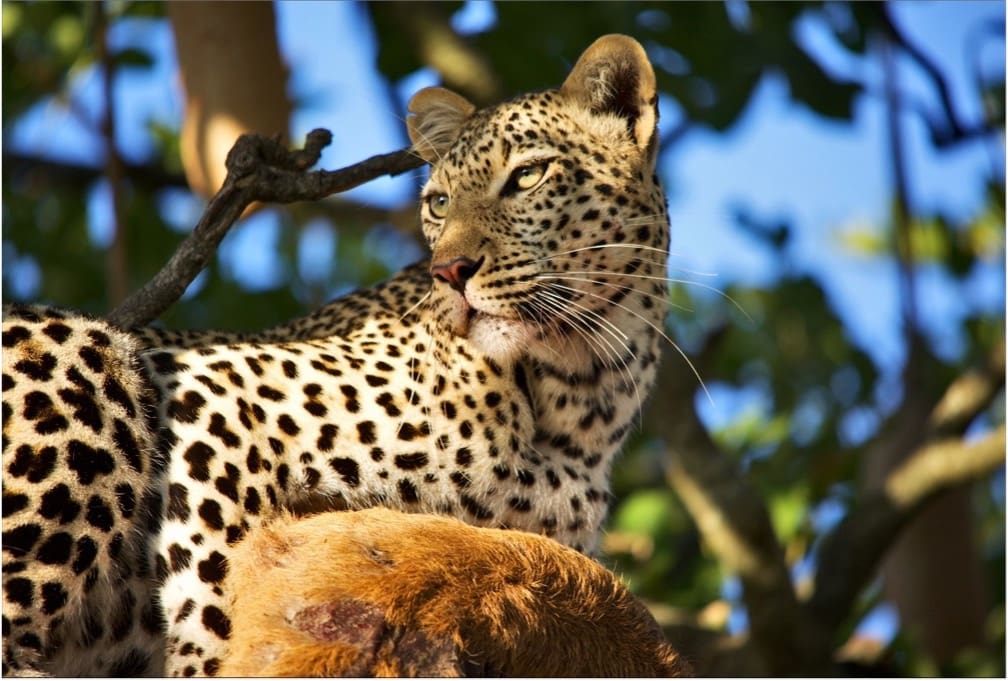
Maridadi means “beautiful” in Swahili, a fitting name for this young leopardess. She is approximately 18 months old and living independently – slightly earlier than typical for cubs to leave their mothers. Maridadi is the daughter of the well-known Raho female leopard, another resident predator in the area.
After leaving her mother’s side, she began establishing her own territory in the Grumeti Reserve. Her new territory touches the edge of her mother’s, which is common when young female leopards branch out. Guides have encountered her in places like Raho Drainage, near Nyasirori Ranger Post, and east of Sabora Camp.
She has been described as graceful and curious, with striking features that match her name. In one early sighting, she demonstrated both hunting instinct and caution stalking potential prey but retreating wisely when approached by a competitive hyena, then climbing a tree for safety. More recently she has been seen with prey that include a Thomson’s gazelle kill hoisted in a sausage tree south of Sabora Camp, a young zebra fawn on Sabora Plains stashed in a balanitis tree, and a bohor reedbuck.
She’s becoming a very capable young hunter, and is such a pleasure to admire and photograph. Just look at her clear golden-green eyes, pink nose and enviable whiskers! Leopard whiskers are highly sensitive, elongated touch receptors packed with nerve cells that act as a “silent superpower” for navigation and hunting in low-light, dense terrain. They detect minute air currents and vibrations, allowing leopards to gauge spatial awareness and navigate without relying solely on sight.
Download the full report