November unfolded as an extraordinary month for wildlife movements in Grumeti. The short rains received in October had left the landscape lush and inviting, drawing large numbers of ungulates back into the area. Yet despite this earlier rainfall, November itself remained relatively dry. The Grumeti River receded to a gentle, crystal-clear flow gliding over the sand and several smaller ponds across the open plains dried up completely. With fewer watering points available, animals were naturally funnelled toward the remaining sources particularly Sasakwa Dam, creating impressive concentrations of wildlife in that area.
By early November, the migratory herds that had departed at the end of October began to return. From the 10th onward, wildebeests and zebras turned back toward Grumeti after finding no rain and therefore no grazing opportunities in the direction they had been heading. Within just a few days, by the 15th, Grumeti transformed into a true wildlife paradise. Vast herds blanketed the Ikorongo region and spread across the plains of Sasakwa and Sabora, restoring a sense of movement and vitality to the landscape. This year, we have also experienced the migration staying in Grumeti far longer than in many previous years, an exciting and notable shift for the area. These returning herds provided ample food for the ever-watchful predators, helping them remain strong and healthy. Young carnivores continued to grow rapidly, supported by the abundance around them.
Here’s November sightings snapshot for Grumeti:
Lions
November was an incredible month for sightings of these magnificent big cats of the wild. We encountered them almost daily, whether tucked within the woodlands of the Ikorongo region, resting along the Grumeti riverbed, roaming the central open plains, or hidden in the dense thickets. Their steady presence added excitement and wonder to every drive. In fact, the Grumeti Reserve is one of the few places where you can confidently assure a traveller that they will see lions during a two-day safari.
- Butamtam Pride with their cubs stayed east of Observation Point 7 and sometimes moved up to the shoulder of the hill in the afternoons.
- Sabora Pride stayed around Sabora camp, around Sabora Morum Pit, Fisi Plain and Sabora Drainage. We saw a mating pair amongst the pride members and hopefully we will see new cubs in months to come.
- Kombre Pride wandered along Farasi Road, Chui Link Road, Sasakwa Hill and Arab Camp thicket, Arab Camp Road and marsh areas.
- The five Nyasirori nomadic young male lions were seen at Kigelia Crossing, along Nyati plain and Raho Drainage. They keep gaining their strength and were seen once trying to acquire two females from Sabora Pride unsuccessfully.
- Mkuyu Pride lions were seen often lying in the Grumeti riverbed downstream of German Bridge during the month, and they took advantage of the prey animals that came to drink.
- West Pride was seen along Raho Drainage south of Marula and Balanitis Explore Camps and, on the plains, west of the camp.
- Albizia Pride members were seen along Kombre Drainage upstream of Double Crossing, along Albizia woodland and north of the drainage towards the border.
- Rokare Pride was seen near Mbega Bridge lying in the Grumeti riverbed.
- A mating pair was seen at the Grumeti River and Chumvi Drainage confluence.
Leopards
November was an unforgettable month for leopards, marked by several incredible encounters. One individual offered a particularly remarkable sighting, remaining in the same area for five days after hoisting a young zebra kill high into a tree. As always, leopard sightings carried a sense of awe, never taken for granted, but deeply appreciated as one of nature’s most beautiful gifts.
- Mbogo Drainage male was seen up in a false marula tree along Mbogo Drainage, north of Faru Faru Lodge.
- Mbogo Drainage young male was seen feeding on a warthog piglet in the Mbogo Drainage.
- Kombre male was seen north of Arab Camp Hill and the marsh area.
- Grumeti North male was seen in the middle of the month with a zebra foal up in a tree, a few hundred meters west of Faru Faru Lodge.
- A big male was seen along Grumeti River.
- Mbogo Drainage female was seen with a reedbuck kill along Mbogo Drainage.
Cheetahs
Cheetah sightings were slightly low in November, which only increased the excitement surrounding each drive. So, when a cheetah was finally spotted, the moment felt exceptional, full of awe and appreciation. With fewer sightings, the eagerness to find one grew, making every encounter with these cats especially memorable and deeply rewarding.
- The dominant male was seen along Pundamilia plain, Old School and Nyati plain.
- Another male was seen south of Kombre Drainage and mash area.
- There was a new unknown female seen south of the German Bridge on the eastern side of Grumeti River.
Elephants
November, just like last year, once again proved to be the height of elephant sightings. In the Sasakwa region, where elephant numbers remain impressively strong, we could often watch large herds gathering at the Sasakwa Dam around mid-morning to drink. It wasn’t unusual to see as many as 100 elephants at once, families, young bulls and playful calves moving together in a great, gentle tide of grey. For our guests, witnessing such a magnificent congregation so regularly turned each day into something extraordinary, a reminder of the wild magic that defines this remarkable Grumeti.
- There were decent-sized herds moving around the Mbogo Drainage, Faru Faru Lodge, and Grumeti North areas.
- The highest concentrations for the entire month were recorded on the Sasakwa plain, Sasakwa Hill, Kombre Drainage, RISE, and the EEC centres, where herds of about 100 individuals in a single group were witnessed roaming.
- The Sabora and Raho Drainage areas held smaller herds throughout the month.
- Gambaranyera, Balanitis, and the Marula Explore Camp areas also hosted smaller herds.
- Large herds were observed along the Albizia woodland, the marsh areas, and the Biribai zones.
- The Ikorongo areas had several small herds scattered across the region, stretching from Nyati Camp and Nyamamba plain to Manchira River, Rokare River, and along Nyabehu River.
- There were also great herds observed along the Grumeti west areas, including Koroya Hill, the Colobus Crossing, and the German Bridge area.
Buffalo
November brought a calm but consistent presence of buffalos across the reserve, with herds appearing in both medium and larger herds as they moved through their home ranges. Some bachelor bulls roamed nearby, their solitary presence a quiet reminder of the wild’s untamed spirit. Together, these sightings painted a vivid picture of a thriving, harmonious wilderness.
- There was a very large herd seen moving in-between Pelican Pan, Colobus Crossing and Romoti Triangle areas.
- In the Albizia woodland there were two large herds seen moving upstream and downstream of the woodland, marsh area and Kongoni Scout’s Camp.
- A huge herd seen around German Bridge, Martin’s Hill and Ikoma Drainages and Mbuni Hill areas.
- There was a large herd moving across Sabora plain, Nyasirori Ranger post, Sabora Drainage and Fisi plain.
- A very large herd was seen moving in between Manchira River and Pofu plain.
- Another large herd grazed around Serengeti House, Chui Link and the Old School areas.
- A medium sized herd was observed west of Sasakwa Dam.
- A small herd was seen spending time in the vicinity of the Sasakwa airstrip.
Rhinos
The rhinos in the IPZ have been regularly seen by our anti-poaching team. They are all in good condition and several females were seen with calves.
November sightings snapshot for Lamai:
In the north, the small groups of migratory animals that had lingered around Lamai finally moved on in the middle of the month. Their departure opened up space for resident game, which quickly reclaimed the area.
Overall, November beautifully revealed the dynamic rhythm of the Grumeti ecosystem. Subtle shifts in conditions guided the movements of vast migratory herds and influenced where animals gathered and grazed. These changes, in turn, shaped the delicate balance between predator and prey, creating moments of intensity, abundance, and renewal across the plains. The interplay of all these elements, water sources, wildlife, and movement made November not just an active month, but one of the most captivating and remarkable periods we have witnessed in this area.
Lions
In November, three prides were regularly seen throughout the month, each remaining closely tied to its territory, which made sightings remarkably reliable for those hoping to find them. Early mornings were very rewarding, as the lions were mostly active before the sun rose and the heat set in. And, as always, Lamai lived up to its reputation, delivering consistent, memorable lion encounters that left our guests thrilled.
- Mawe Meusi Pride members were moving around the boundary areas all the way to Korongo la Fisi.
- Kigelia Pride was observed roaming around the areas of Korongo la Saa Kumi, Korongo la Minazi and Korongo la Kigelia.
- There was another pride of four lionesses seen at Chala la Majangili a few times, early in the mornings, as they would retreat into the bushes soon after sunrise.
Leopards
Despite being naturally elusive, there were excellent sightings of these beautiful cats. They took full advantage of the last remaining migratory herds for food and were often seen with young wildebeest and zebra kills hanging up in the trees. Their presence brought a fascinating glimpse into the rhythm of life and survival in the Lamai area.
- A mating pair was seen actively for about three days along the Kenyangaga Drainage.
- Mother and one cub seen with a wildebeest calf kill along the Mara River.
- A female was found with a wildebeest calf kill up in a balanitis tree, west of Kenyangaga Drainage.
- A male was found with a zebra foal up in a balanitis tree along the Kenyangaga Drainage.
Cheetahs
There were two impressive cheetah coalitions in the area, one made up of three brothers and another of two. Their consistent presence throughout the month brought extraordinary energy to the region, providing our guests with exceptional and unforgettable sightings.
- A coalition of two brothers was seen on the kopjes north of Mara River Tented Camp.
- Another coalition of three male cheetahs was seen mostly around the Massai Mara and the Serengeti boundary.
Elephants
We encountered elephants on nearly every drive, sometimes lone wanderers, sometimes large herds and small herds spread across various parts of the Lamai Triangle. Their calm presence and gentle movements added a sense of magic to each moment we spent in the bush.
- Kenyangaga Drainage was the hot spot for elephants – there were several herds seen almost every day.
- There was an impressive herd seen along the Mara River both upstream and downstream of Mara River Tented Camp.
- Other smaller herds were seen feeding contently in the areas of abundant new growth.
- There were several bulls seen scattered about at Kampikampi Plain.
Buffaloes
As the numbers of wildebeest began to decrease, herds of buffalo started appearing across the landscape. We found them in different areas, moving slowly through the grasslands and adding a strong, steady presence to the changing scene. Feeding in the early mornings and again in the evenings, they spent the hottest hours of the day resting to escape the heat.
- A very large herd was seen moving across the Kampikampi Plain, Daraja Mbili, and other areas of Kenyangaga Drainage.
- Large herds were also observed along Korongo la Fisi and Mawe Meusi towards the Maasai Mara and Serengeti boundary.
- Several bachelor bull herds and solitary bulls were scattered across the open plains.
Plains game
The general game viewing was simply incredible, with several herds of topis and gazelles roaming the plains alongside the last remaining herds of migratory wildebeests and zebras, creating a vibrant tapestry of wildlife in motion.
Other interesting sightings
In November, only a few wildebeests and zebras remained, all of which crossed the Mara River before the month came to an end, allowing a few resident animals to stay behind. The plains were still alive with activities, as unusual large numbers of vultures patrolled the skies along the Kenyangaga Drainage and majestic Abdim’s storks soared gracefully overhead, adding vibrant movement to the landscape.
Witnessing a leopard kill
Story by Grace Matemba
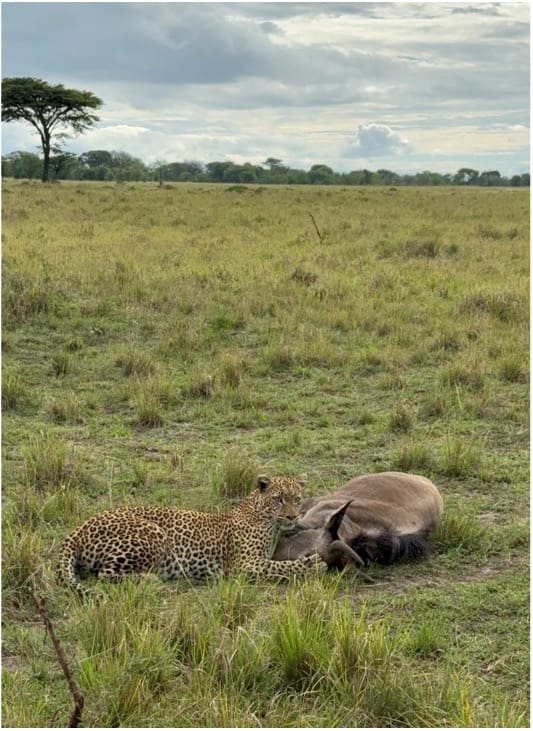
In early November, during a morning game drive in the Lamai Triangle, I experienced one of the most extraordinary and rare wildlife moments. The day began quietly as I made my way down toward the Mara River, enjoying the peaceful early light and the stillness that often settles over the landscape at dawn. Everything felt calm and unhurried. As I continued into the woodland, scanning the area as I usually do, I came across something completely unexpected that instantly transformed the calm morning into a moment of intense excitement.
Right in front of me, a female leopard was in the middle of a dramatic hunt. She had launched herself at a wildebeest calf, and the two were locked in a fierce struggle. The wildebeest calf belonged to a small mixed herd of about twenty animals of wildebeest and zebras. As the action unfolded, the rest of the herd gathered nearby, snorting loudly, stamping, and watching with anxious curiosity. For a moment they stood frozen, unsure whether to flee or stay, but the intensity of the hunt finally drove them to scatter in different directions.
I was fortunate enough to witness the entire event from start to finish. The leopard showed incredible strength for her size, clinging to the much larger animal with astonishing determination. Slowly, through pure persistence, she managed to bring the wildebeest calf down. Once the struggle ended, it became clear just how big her challenge was. The wildebeest calf was far too heavy for her to hoist into a tree, a behaviour leopards rely on to keep their kills safe from lions, hyenas, and vultures. Instead, she took hold of the carcass and began dragging it. With tremendous effort, she pulled it roughly thirty meters until she reached the thick cover of an orange-leaved croton bush, where she could feed to some degree of safety.
I remained at the sighting for over an hour, watching her try to recover from the exhausting hunt. She panted heavily, her sides rising and falling rapidly, clearly using all the strength she had left. After resting for a while inside the croton bush, she eventually got up and moved deeper into the woodland. Respecting her need for space and aware that she might be going to check on something important, possibly cubs, I decided to leave the area and return later.
That evening, just before sunset, I drove back to reassess the scene. To my surprise and delight, the female leopard had returned and she was not alone. With her was her young cub, estimated to be around five months old. The cub, still small and full of curiosity, cautiously approached the carcass but soon grew bold enough to eat beside its mother. Together they fed quietly, side by side, turning the intense drama of the morning into a beautifully tender family moment. The contrast between the fierce power of the hunt and the gentle bond between mother and her cub made the experience even more memorable.
Watching them together in the fading light felt like a gift, one of those rare sights that remind you just how unpredictable and magical nature can be. From the adrenaline of the morning hunt to the peaceful scene of a family sharing a hard-earned meal, this encounter stood out as one of the most unforgettable moments of the month.
Imara, a famous female leopard
Story by Paulo Kivuyo
Imara is one of the most impressive leopards in Grumeti. Her name means “strong” in Swahili, and anyone who has watched her for even a short time can see how perfectly it fits her. She has made the area around Faru Faru her home, holding a territory of about six square kilometres, an area she knows extremely well and moves through with confidence and purpose.
Over the years, Imara has proven herself to be an exceptional mother. She has raised three cubs from two different litters. Her first litter was a single male, and her second litter had two cubs, one male and one female. What makes her even more impressive is that all three of her offspring are still alive, now roaming the western side of her territory. For a leopard living in an area with so many dangers, this is a remarkable achievement. Meanwhile, Imara has shifted her own core area a little further east, spending more time around Faru Faru lodge, following the Grumeti River and moving through the Mbogo Drainage just north of the lodge.
Raising cubs in this landscape is no small task. Imara’s territory lies between two lion prides’, the Faru Pride and the Mkuyu Pride. Lions are a major threat to leopards, especially cubs. Several times, guides have witnessed lions aggressively chasing Imara, even when she had tiny cubs hidden nearby. But every time, she has shown incredible intelligence and determination. She knows exactly when to hide and when to run. Her quick decisions have saved her cubs many times, proving just how strong and capable she is.
Not long ago, she was seen near Faru suite 9. Her teats looked swollen with milk, a clear sign that she had a new litter tucked away somewhere, her third litter. The fact that she is raising cubs again in such a high pressure area filled with lions, hyenas, and other threats shows just how fearless and resilient she is.
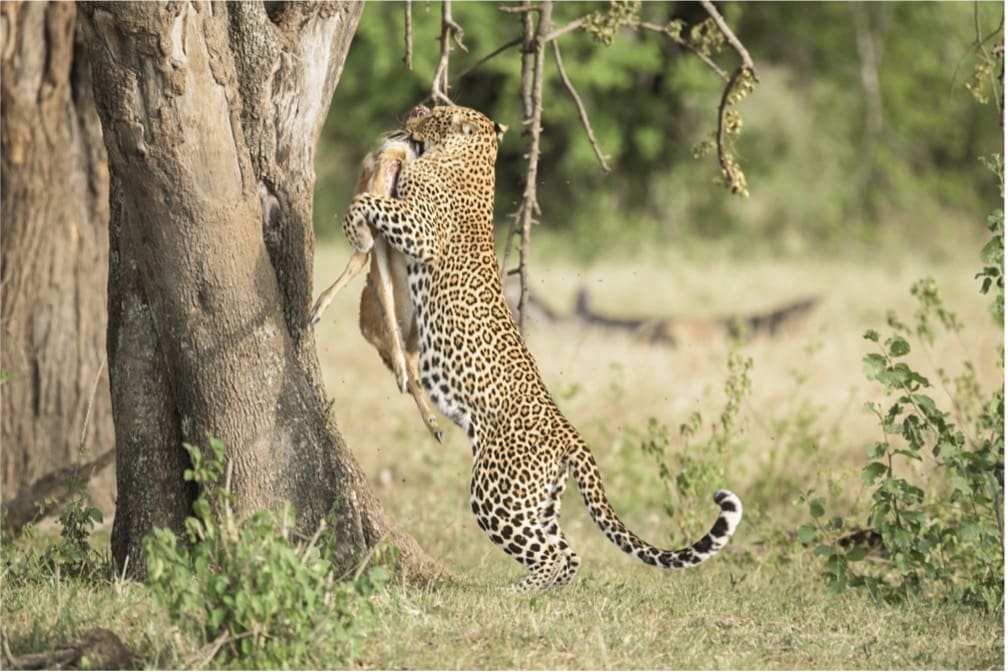
As we followed her during that sighting, Imara suddenly stopped. Her whole body dropped low, and her eyes focused sharply on something hidden in the tall grass. For a moment, we could see nothing, just grass moving softly in the wind. Then she sprang forward, disappearing into a thick bush. A single reedbuck call echoed through the air, short, sharp, and final. Moments later, Imara emerged carrying a reedbuck kill in her jaws. She dragged the kill to a nearby tree, expertly climbed up the trunk, and hung it safely across a branch. After eating only a small amount, she descended and slipped away, almost certainly heading back to her cubs.
The following day, we checked the kill, but she was nowhere to be seen. Then, the next evening, she returned. She climbed up, took the carcass, and moved it to another tree for more safety. Watching her work was like watching a master at her craft, calm, efficient, and incredibly strong.
Imara continues to show why her name suits her so well. She is powerful, smart, and endlessly determined, a true survivor in a challenging environment. And now, with a new litter hidden somewhere in her territory, we wait with excitement and hope, eager for the first glimpse of her next generation.
Kisikio, the dominant male cheetah
Story by Gadmel Kimaro
In the vast golden plains of Grumeti Reserves, where the grasses whisper secrets and the wind carries stories, there roams a cheetah unlike any other. His name is Kisikio — “the one who listens.” He earned his name not only from the small hairless patch on his right ear, but from the way he moves through the plains. Kisikio is always alert, ears twitching and head tilting as though he hears things the rest of the savanna easily misses. Guides often say he listens with more than his ears, he listens with his whole body. Guests who see him feel as though he is reading the landscape, tuning himself to every breath of wind and shift of movement around him.
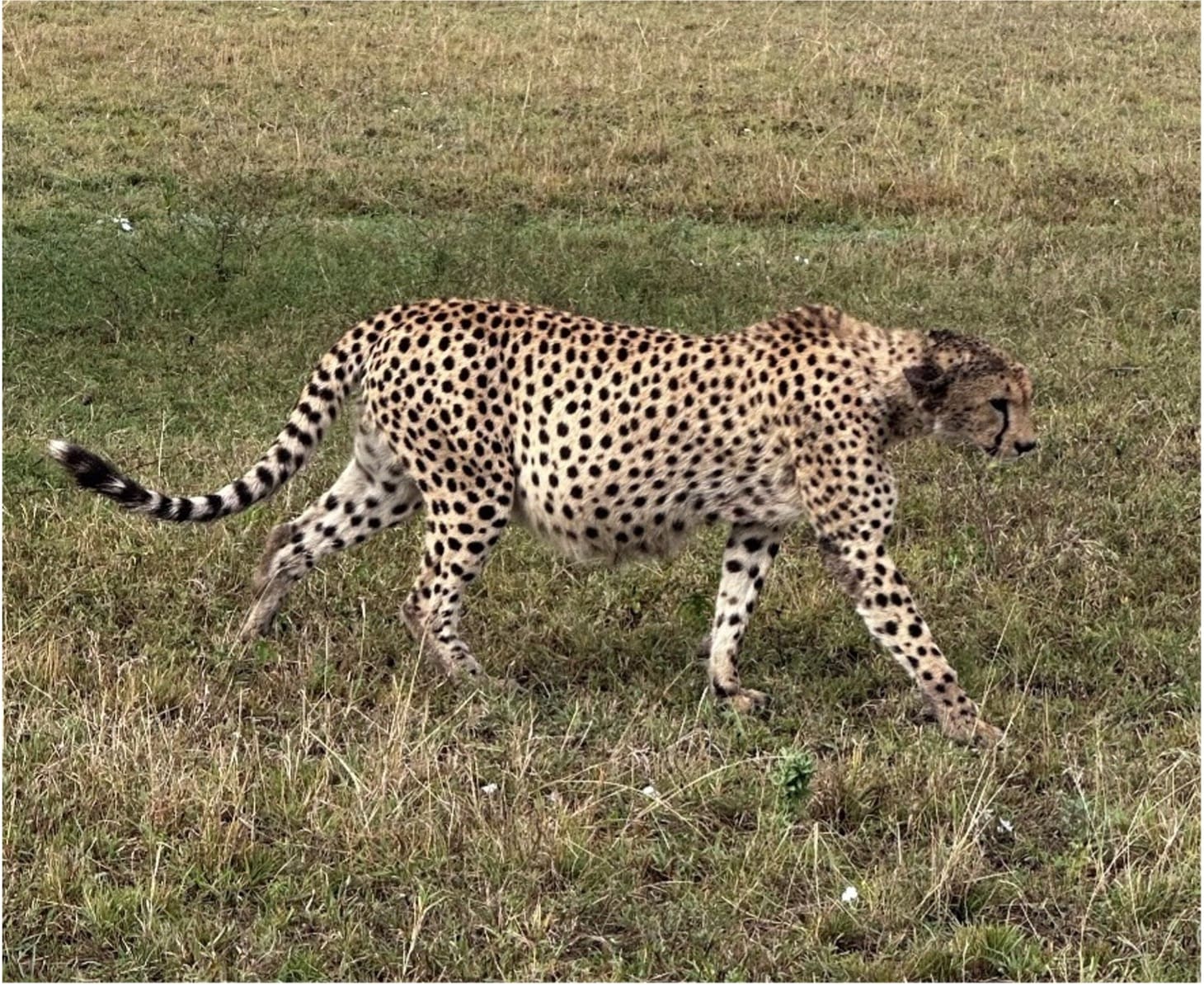
Kisikio is a dominant solitary male in his prime. Sleek, powerful, graceful, and confidently roaming a vast range from Sasakwa plain to the Nyasirori areas, and there are few cheetahs in the area. With fewer rivals compared to the roaring cats of the night, he moves like a prince whose kingdom stretches with the horizon. Yet what truly sets him apart isn’t his speed, though he can streak across the plains in a blur of dust and gold, it is his patience.
This year, the Great Migration was here for the whole of June while on the move towards the north; and again it has been in the reserve for the three months of September, October and November. Throughout this time Kisikio relies almost entirely on wildebeest calves. He knows the herds intimately, their patterns, their hesitations and their vulnerabilities. Whenever guides find him with an empty belly and wildebeest grazing nearby, everyone quietly prepares themselves to see a hunt. With Kisikio, an empty stomach and the presence of calves almost always means action.
One hot afternoon, with the sky shimmering from heat and the grass crisp underfoot, Kisikio watches a herd from a distance. He doesn’t rush. He doesn’t crouch. He simply listens to the wind brushing through the bushes, to the soft bleats of calves trying to keep up with their mothers. He waits for a shift so subtle most creatures would overlook it.
Then, without warning, he moves. Low, silent and unseen. In seconds, he becomes a streak of muscle and precision as the herd erupts in panic. Dust lifts, shadows scatter, and Kisikio singles out a calf that hesitates just a heartbeat too long. The moment is clean, efficient, and deeply respectful, the way Kisikio always hunts.
Even exhausted, he wastes no time. He drags his kill into a little cover nearby, hiding it from the circling vultures that glide overhead like silent alarms. Once under shade, he opens his hard-earned meal quickly, eating with urgency but never carelessly. Every few bites, his head lifts. His ears tilt. His eyes sweep the landscape. He listens to the wind, to the grass, to the distant calls, making sure no lion, hyena, or opportunistic predator takes him by surprise. In every movement, he shows what survival truly looks like, swift, aware, and always listening.
For guests who follow his story, Kisikio has become more than just a cheetah. He is a symbol of focus, presence, and harmony with the land. Repeat visitors often ask with excitement, “Have you seen Kisikio today?” Because when he is around, and wildebeest calves are near, something extraordinary is always possible.
In Grumeti, the wind still carries his story, Kisikio, the silent prince of the savanna, the hunter who survives not by being the fastest or the strongest alone, but by being the one who truly listens.
Download the full report