October in Grumeti was nothing short of breath-taking, it was a continuation of Nature’s grand performance that began in September. With the short rains now well established, the landscape has transformed into a sea of lush greenery. What had been dry and golden weeks earlier was now alive with colour, texture, and sound. The ground stretches like a soft green carpet across the concession, sparkling under the sun after each refreshing downpour. Everywhere you look life thrives, from the smallest insects to the largest of mammals, all responding joyfully to the renewed abundance.
The great migratory herds that had arrived in September remained in full force, painting the plains and open woodlands with their immense presence. Wildebeests, zebras, topis and gazelles grazed side by side, their movements orchestrated like a living wave rolling through the grasslands. Food was plentiful, water was within easy reach, and the animals took full advantage of this month of plenty. It was a time of contentment, the herds feeding lazily during the cool hours of the day and resting peacefully in the hot afternoons, the rhythm of life dictated by the rains and the greening of the land.
Yet, where the grazers flourished, the predators thrived as well. Lions, their bellies full and coats shining, lounging under shady trees or watched quietly from termite mounds, always alert for opportunity. Hyenas patrolled the plains, their calls echoing through the night, while leopards moved silently through the riverine and thickets, their presence felt more often than seen. Even the cheetahs, with their unmatched speed, made the most of the open plains, hunting with precision and grace. The balance between predator and prey was evident, a captivating rhythm of life and survival moving in harmony with the landscape.
The Grumeti River and Sasakwa Dam were rejuvenated once more, their waters rising steadily as the rains continued. By late October, a few dramatic moments unfolded as wildebeests and zebras began to cross the Grumeti River, heading slowly southward as the great migration continued its timeless cycle. The crossings were filled with tension and awe, a vivid reminder of Nature’s persistence and the instinctive drive that keeps this migration in motion year after year.
Meanwhile, beyond Grumeti, the Lamai Triangle offered an equally remarkable display of wildlife in motion. Vast herds blanketed the open plains and woodlands, their steady movement creating a living tapestry of sound and colour. Thousands of wildebeests and zebras bravely crossed the Mara River as they made their way south, following the instinctive pull of the migration. It was a breath-taking scene, the land alive with energy, rhythm, and purpose. Guests experienced unforgettable moments in both Lamai and Grumeti, where the spectacle of Nature unfolded on a truly grand scale, each destination echoing the same wild harmony of life.
In a nutshell October in Grumeti was, without question, a month of pure magic! The land alive with renewal, the air rich with the scent of rain and grass. It was a month that reminded us why Grumeti stands among the most extraordinary places on Earth, a sanctuary where Nature’s beauty and power come together in perfect harmony.
Here’s October sightings snapshot for Grumeti:
Lions
October was truly amazing, as we encountered nine different lion prides, making our guests’ experience unforgettable. With some prides having young cubs, others with playful juveniles, and a few consisting only of majestic adults, every guest’s wish was fulfilled. The diversity and activity among the prides made each sighting a unique and memorable highlight of the month.
- Sabora Pride members were seen along West Link Road, around Sabora Morum Pit, Sabora Drainage and around the camp as well.
- There was a coalition of five Nyasirori young lions at a stage of being nomadic while looking for suitable area to establishing their territory. We saw them along Raho Drainage, south of Nyasirori Ranger Post and the Nyati plain.
- Interestingly, four Momukomule males have now taken over Ridge Pride, and are now the territorial males of three prides namely Butamtam, Momukomule and Ridge.
- Momukomule Pride members were seen in front of Serengeti House often, south of Chui Link, along Kombre Drainage, along Ovambo and up on the Sasakwa Hill.
- West Pride was seen along Raho Drainage south of Marula Explore camp, along Mbuni Crossing and Spine Road.
- Rokare Pride was seen at Mbega Bridge, west of Bangwesi Hill and along Rokare Drainage.
- Bangwesi Pride was seen at Nyamamba plain, Manchira River and along the Grumeti River, north of Bangwesi Hill.
- Mkuyu Pride spent time along Grumeti River east of Mbuni Hill, along Ikoma Hill, Grumeti North Drainage and Pelican Pan areas.
- Butamtam Pride stayed mostly in one location north of Serengeti Hill and east of OP 7 due to the age of their cubs. All cubs are in good shape.
- Kawanga Pride was seen along the open plain south of Kawanga scout’s camp, and west of Raho Drainage.
Leopards
October was an incredible month for leopard sightings, truly very special. These elusive cats were spotted regularly across the concession, making their presence known in a way that felt both rare and magical. From the dense thickets of Bangwesi to the open woodlands of Faru and the grasslands near Sabora, leopards graced us with consistent and often breath-taking appearances. Both our esteemed guests and guides were treated to a variety of encounters:
- Raho female was seen with a full grown female ostrich kill along Raho Drainage.
- Maridadi was found with a bushbuck kill up in the sausage tree south of Sabora camp.
- Mbogo Drainage young male seen in the Mbogo Drainage north of Faru Faru Lodge.
- A male leopard seen up in the balanitis tree west of Bangwesi Hill.
- A female was seen along Sand Road east of the balloon lounge site.
- A shy male was found with a wildebeest calf kill up in the tree along Raho Drainage.
- A shy male was seen few times around German Bridge and Sand Road.
- Grumeti North female was seen west of Grumeti River.
- Kombre male was seen up in the false marula tree at the Arab Camp woodland.
Cheetahs
There was a noticeable increase in cheetah sightings. These elegant predators were encountered more frequently across the reserve, offering incredible viewing opportunities and unforgettable moments. Their presence added a special touch to the overall safari experience, making October truly exceptional.
- The resident male was seen moving in between Nyati plain, south of Pundamilia Hill, south of Nyasirori Ranger Post and Sabora Access.
- A female with two young cubs were seen along Nyati plain.
- A female with a sub-adult cub was seen at Gambaranyera plain.
- A young male was seen south of Nyasirori Ranger Post.
- A male was seen south of Bangwesi Hill.
- A new full grown male was seen for the first time up on the Serengeti Hill.
- A male was seen along Sabora Access Road heading to Rubana River.
Elephants
These majestic creatures of the wild were spotted across a variety of habitats, including woodlands, riverine areas, and open plains. In some regions, we observed massive herds of around 100 individuals, while other areas hosted medium-sized and smaller groups. This incredible diversity in herd size and habitat highlighted their adaptability and social dynamics. Each sighting offered a deeper appreciation of how these animals thrive and interact within their natural environment.
- Faru area experienced frequent elephant activity throughout the month, with herds visiting during the night and seen drinking and wallowing at the waterhole in front of the lodge during the afternoons.
- Grumeti River hosted the largest herds, offering excellent viewing opportunities of these magnificent creatures as they roamed and fed along the riverine habitat.
- Sasakwa plain had several smaller herds, often observed drinking at the Sasakwa Dam at various times of the day.
- Ikorongo region had decent-sized herds seen along the Rokare drainage, Manchira River, Nyamamba plain, and the slopes of Bangwesi Hill.
- Kombre Drainage, as always, had herds seen from Sasakwa Airstrip all the way to the Albizia Woodland.
- Sasakwa Hill frequently had small herds seen at night, which descended onto the open plains in the morning.
- Watershed, Rhino Rocks, Biribai, and Mbogo Drainage areas had large herds moving through during the month.
- Sabora plain, Rubana River, and Explore camp areas had smaller herds seen regularly.
- Balloon lounge site, Koroya Hill, and the Ikoma and Grumeti North Drainages also hosted large herds, providing impressive sightings throughout the period.
Buffalo
Buffalo viewing has been equally impressive this month, with large herds moving steadily across the reserve. From Ikorongo to Gambaranyera, groups of these powerful grazers were seen making the most of the fresh, green grass brought on by recent short rains. The landscape seemed to come alive with their presence, especially during the cooler hours of the day. These herds frequently gathered around water points in the mid-morning and again in the late afternoon, creating dramatic and memorable scenes of wild Africa in motion. It’s been a remarkable period for observing buffalo behaviour and movement across the concession.
- A huge herd was seen moving around Koroya Hill, Pundamilia Hill, Nyati plain, and the den-site area.
- Sasakwa plain hosted two large herds, one on the western side of the Sasakwa Dam, Ridge Hill, Op 7, and Butamtam Drainage, and another along Farasi, Chui Link, Arab Camp Thicket, and the Old School area.
- A big herd was sighted near Nyasirori Ranger post and along the Raho Drainage.
- A huge herd was observed across Fungo, Sabora Plain, and Fisi Plain.
- A large herd was seen moving through Pofu plain, Nyamamba Bridge, and Manchira River.
- Another large herd was observed roaming between Bangwesi Hill and Nyati scout’s camp.
- A very large herd was seen west of the Rokare River and near Mbega Bridge.
- Another very large herd was sighted both east and west of the Grumeti River, close to Colobus Crossing and Romoti areas.
- A small herd was observed roaming near the Sasakwa Airstrip.
Rhinos
While October didn’t bring any rhino sightings, we’re looking forward to encounters in the coming months.
October sightings snapshot for Lamai:
Lions
With the large herds of migratory animals in the area, lion viewing became an incredible experience, as the predators didn’t need to move much with abundant food all around. October highlighted the Lamai as a spectacular destination for wildlife enthusiasts, offering unforgettable encounters with these cats.
- Kigelia Pride, the dominant pride on the Lamai Triangle, spent most of the month along Korongo la Minazi, Korongo la Saa Kumi, and the high grounds in between.
- Another pride was observed moving around the areas north of Mara River Tented Camp.
Leopards
Frequent leopard sightings offered unforgettable glimpses of the region’s rich and diverse wildlife.
- A famous female leopard, known as Bhoke, was frequently seen along a drainage system.
- A female leopard with one sub-adult cub was spotted at Kogatende Bridge, in the woodland near the river, and along the drainage east of the bridge.
- Two male leopards were observed engaged in a territorial dispute, with one up in a tree and the other sitting beneath it, growling at each other along the Kenyangaga Drainage.
Cheetahs
Without cheetahs, the Lamai Triangle would feel incomplete. These incredible predators were frequently seen both on the open plains and within the woodlands, adding excitement and energy to every game drive. Their presence is a reminder of the wildness and balance that define this remarkable ecosystem.
- A coalition of three male cheetah brothers spent most of October on the Kampikampi open plains, around the Maasai Mara and Serengeti boundary. Unaware of human-made borders, they freely moved between the two countries.
- Another coalition of two male cheetahs, the legends of the Lamai Triangle was seen near the Morum pit, west of Access Road, as well as along the Mara River and the Alex Walker open plains.
Elephants
October was not short of these magnificent creatures, as they were spotted on nearly every game drive whether out on the open plains, within the woodlands, or along the riverbanks.
- Several large herds were spread along the Kenyangaga drainage, stretching from the Mara River Tented Camp all the way upstream towards Daraja Mbili. Smaller herds were scattered across the Kampikampi plain, Korongo la Fisi, and Korongo la Minazi these open areas.
- Several bachelor bulls were also seen roaming independently across the plains.
Buffaloes
Buffalos were often seen mingling with the wildebeest herds, diffusing their presence.
- A very large herd was seen moving across the Kampikampi plain, Daraja Mbili, and other areas upstream toward the Maasai Mara boundary. Large herds were also observed along the Mara River, both upstream and downstream of the Mara River Tented Camp.
- Several bachelor bulls and solitary bulls were scattered across the open plains.
Plains game
Gazelles, topis, and giraffes were seen mingling with the migratory wildebeest and zebras, filling the open plains and woodlands. The mix of species created a lively and beautiful scene across the landscape.
Other interesting sightings
The wildebeest migration remained the highlight of the Lamai Triangle throughout October, with several dramatic river crossings. Large herds continued to push southwards, crossing the river as part of their ongoing journey. The sheer number of wildebeest and zebras on the move created breath-taking scenes!
Some bush stories follow, as well as our October Gallery.
Raho female hunts an ostrich
Story by Edward Kaaya
It was mid-October when I left early for a morning game drive with my guests, full of hope and excitement for what the day might bring. The air was cool and fresh, and the first golden light of dawn spread gently across the plains. That morning, we set out with a clear intention, to find a leopard, the one animal my guests most wanted to see. We drove for hours, scanning the bush carefully, every flicker of movement drawing our attention. Behind me, my guests kept laughing and teasing, reminding me that the leopard was the only creature missing from their list.
Around 10:00 a.m., our patience finally paid off. I spotted the very elusive cat resting high up in a balanitis tree south of Raho Drainage. It was the well-known Raho female, the mother of Maridadi. The moment I pointed her out, the vehicle filled with joy and excitement.
As we admired this magnificent leopard, we noticed that she was watching a Thompson gazelle sleeping about 50 meters away. Unfortunately, there was no cover for her to stalk it. We sat quietly for nearly an hour, enjoying her calm beauty and hoping she might make a move or hunt. By 11:00 a.m., my guests agreed that they’d had a wonderful sighting, so we decided to return to the lodge for brunch and a rest, planning to come back in the afternoon.
At around 16:00, we went out again, headed straight back to where we had left the Raho female. When we arrived, we were completely amazed at what we saw. Right under the same tree, she had killed a full-grown female ostrich. We could hardly believe our eyes! In my 18 years of guiding here at Grumeti reserves, this was only the second time I had ever seen a leopard with an ostrich kill.
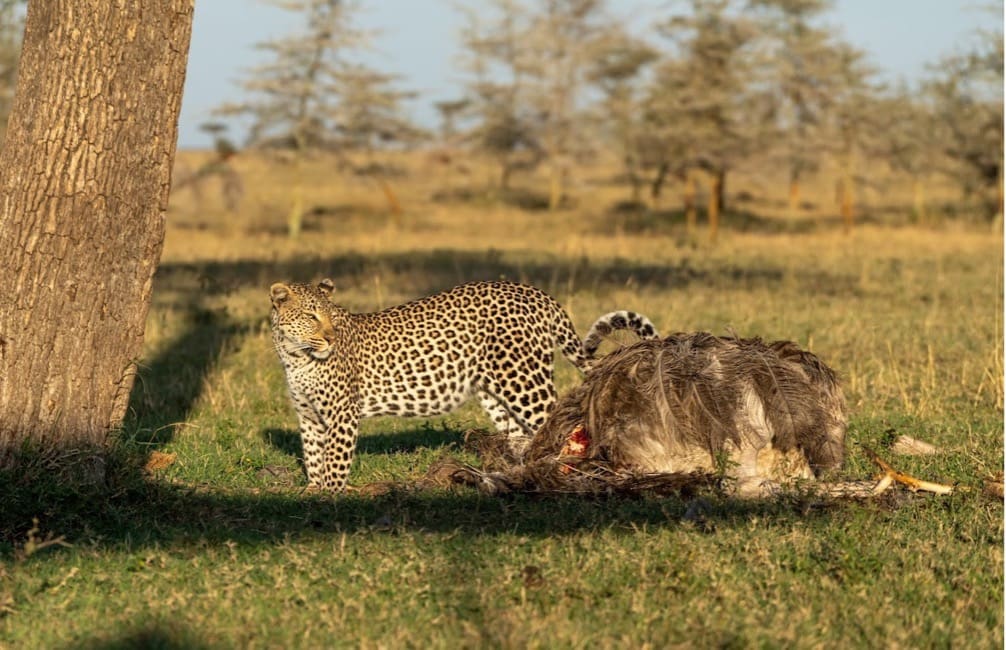
Usually, a leopard drags its kill up in a tree to keep it safe from scavengers, but this time the kill was far too large to carry. The ostrich weighs around 100 kilograms or more, while the leopard herself was only about 45 kilograms. So, she had no choice but to feed on the ground.
The next morning, we returned to see what had happened. To our surprise, she was still there with her kill under the tree. No hyenas or lions had discovered it yet. She continued eating and rested in the nearby tree, looking completely content.
On the third morning, my colleague visited the same spot and found that scavengers had finally located the carcass. The Raho female was still nearby, her belly full, resting peacefully in the tree and enjoying the cool morning breeze.
It was a breath-taking and unforgettable experience. Nature never stops amazing us, imagine a leopard weighing just 45 kilograms managing to bring down a bird almost three times her size. Truly remarkable!
A rare sight of a pangolin
Story by Edward Kaaya
It was late afternoon during one of my game drives on the reserve, guiding a lovely family staying at Sasakwa Lodge. Our plan that day was clear, we wanted to find the Butamtam Pride and, hopefully, see their young cubs. The sky was heavy with clouds, dark and low, as if rain could fall at any moment and eventually, it did.
We set off from the lodge with high hopes, heading toward the area where the pride had last been seen. Along the way, near the slopes of OP 7, we came across two impressive male lions resting on the edge of the hill. Their golden manes stood out beautifully against the overcast sky. We watched them for a few minutes, taking in their calm yet commanding presence.
But my guests were eager to continue, they were keen on seeing the cubs. So, we moved on, driving uphill toward the rocky outcrop where the females had taken their little ones for safety.
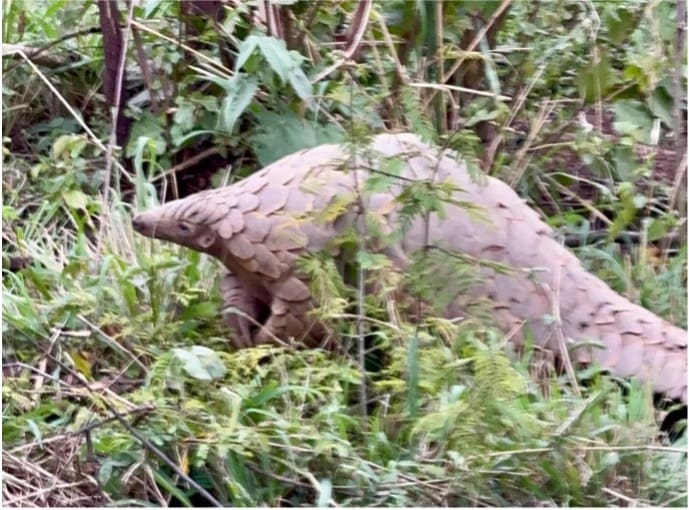
As we approached the area, one of my guests suddenly shouted, “I see a lion cub!” I quickly turned off the engine and looked in the direction they were pointing. But what I saw made me blink in disbelief. It wasn’t a lion cub, it was a pangolin!
I could hardly believe my eyes. A pangolin, one of Africa’s rarest and most elusive creatures, right there in front of us, calmly walking across the open ground. I told my guests, “That’s not a cub, it’s a pangolin! You are witnessing something incredibly special! Excitement filled the vehicle. Cameras came out, smiles widened, and the air buzzed with wonder. The pangolin, seemingly unbothered by our presence, moved gracefully around us, its scales glistening in the soft light before the rain. We sat quietly, watching this extraordinary animal go about its business. We stayed with this special and elusive animal for about half an hour, and forgot all about the lion cubs. It was an exciting afternoon for both guides and guests, a moment so rare that even years of guiding could not guarantee another like it.
The next day, I returned to the area and finally found the lion cubs. But the memory of that pangolin encounter stayed with me, and with my guests, far longer.
As I always tell those I guide, we leave the lodge each day with our own plans, however, Mother Nature has her own. When she surprises us, all we can do is to appreciate every magical moment she chooses to share. It’s in those unscripted, unexpected moments when the bush reveals its true magic.
Wildebeest crossing at Mara River
Story by Nicodemus Temu
A few weeks ago, I found myself near the Mara River, staying in a quiet tented camp, especially positioned to view one of nature’s greatest spectacles, the wildebeest migration. The air was thick with anticipation. Across the plains at Lamai, thousands of wildebeests had gathered along the riverbank, their restlessness hinting that something extraordinary was about to happen.
For hours, we watched as the herd hesitated at the water’s edge. They paced back and forth, testing the river with cautious hooves, sniffing the air, and pulling back again. It was as if the entire herd was holding its breath, waiting for a signal. The silence between their movements was tense, almost sacred.
Then, suddenly, it happened. One brave wildebeest stepped into the water, and in an instant, the rest followed. What had been stillness turned into a storm of movement, a living tide of animals charging through the muddy water. The sound was overwhelming, pounding hooves, splashing waves, and the deep calls of the herd echoing across the valley.
For forty-five minutes, the crossing unfolded before us. The wildebeests pushed forward in waves, driven by instinct and determination. The river fought back with strong currents, and from the shadows, crocodiles waited. We watched in awe and sorrow as three wildebeests were taken, a harsh reminder of how unforgiving the wild can be.
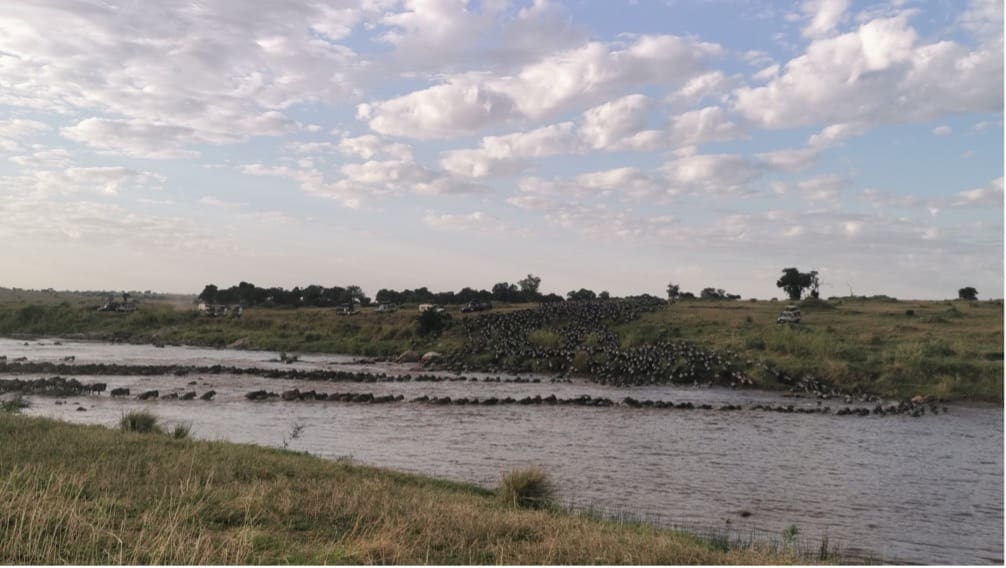
Our group stood quietly on the riverbank, giving the herd plenty of space to move. Vehicles were parked at a reasonable distance, allowing the animals to pass without interruption. Don, a first-time visitor, was speechless, his eyes wide as he watched the raw power of nature play out before him. Around us, the guests were silent too, a mix of excitement and reverence written on every face.
Unlike the frantic crossings of July, this one felt calmer, more measured, almost ceremonial. Yet it was no less thrilling. Each moment carried a pulse of life, a rhythm that reminded us how fragile and magnificent this ecosystem is.
As the last wildebeests climbed the far bank and disappeared into the golden grasslands, a deep calm settled over the river. We stood together, still processing what we had just witnessed. The crossing was over, but its memory lingered, a scene of courage, endurance, and the timeless cycle of life.
We left the Mara River that evening with hearts full of wonder. The migration, we realized, isn’t just a movement of animals, it’s a living story that unfolds year after year. And as we looked toward the horizon, my guests were already dreaming of returning next season to witness the next chapter in this wild, beautiful journey.
Download the full report